Showing posts with label Natives. Show all posts

Wednesday, January 18, 2012

Plant of the Week - The Barbed Wire Tree


"Osage Orange

Maclura pomifera

Maclura pomifera is a paradox plant. It is one of the most widely-planted trees in North America, especially on the plains, yet it has no commercial value as timber, lumber or even pulpwood. Instead, it was used to make high, think, thorny termite- and rot-resistant hedgerows. It did such an admirable job as hedging material, it provided the inspiration for the barbed wire fence that eventually replaced it.

Maclura pomifera
 fruit is known alternately as "Osage orange" or "hedge apple" and is inedible to almost every animal except squirrels. Bois d'arc (Americanized into "bodock") and bowwood are common names that hint back to the native American Indian's use of the wood to make bows.

The fruit is often used as a natural insect repellent, especially for cockroaches and crickets, as well as a dye."

quoted from Dave's Garden E-Newsletter, January 9, 2012

~~~~~~~

The Osage orange is native to the mid-western and southern United States. A mature tree can be 40 feet / 12 meters tall and wide. It is not an orange at all, but part of the mulberry family.


The strong branches make a think interlocking tangle. The thorns are only 1 - 2 inches / 2.5 - 5 cm long, but they are stout, sturdy, and sharp. These features plus planting Osage orange in tight rows made the perfect impassable natural fence.

The specifications of the ideal farmstead hedgerow?
"Horse-high, bull-strong, and hog-tight."


The fruit is unusual and large. It matures to between 3 - 5 inches / 7.6 - 12.7 cm in diameter, and the rind is bumpy and lumpy.


The inside of the fruit is something like a meaty kiwi - plus milky sap. The Osage orange fruit isn't edible for humans, but squirrels, deer, horses and other cattle seem to like it. And they are welcome to it.


When the fruit ripens it falls off the tree. If you ever find yourself strolling under an Osage orange tree in autumn, be sure to bring your hard hat. The fruit shares some of the characteristics of the wood; it is heavy and hard.

Not the most desirable tree for the home landscape.

~~~~~~~

The wood from the Osage orange was actually highly valued by the American Indians, specifically the Osage Indians from Arkansas and Missouri. Stronger than oak and tough as hickory, bows made from Osage orange were considered the finest and the best. If you were in the market for a bow in the 19th century you would need to be prepared to trade a horse and a blanket.

Having no commercial value isn't quite entirely true, at least in terms of being commercially grown for any specific purpose. But my Google Image search showed that i
n addition to bows, Osage orange wood is used to make a host of things: handles for knives, hatchets, and nun-chucks (yes, really!), rifle stocks, bowls, vases, canoe paddles, recorders, guitar faces (sorry if wrong terminology), snare drum binding, clothing buttons, and boomerangs.

Apparently dyes are still made from the Osage orange fruit. The resulting color is orange in various hues, but it is also used to make a variety of colors when applied over pre-dyed fiber.


all photos are from Google Images

Monday, April 25, 2011

Plant of the Week: Bloodroot

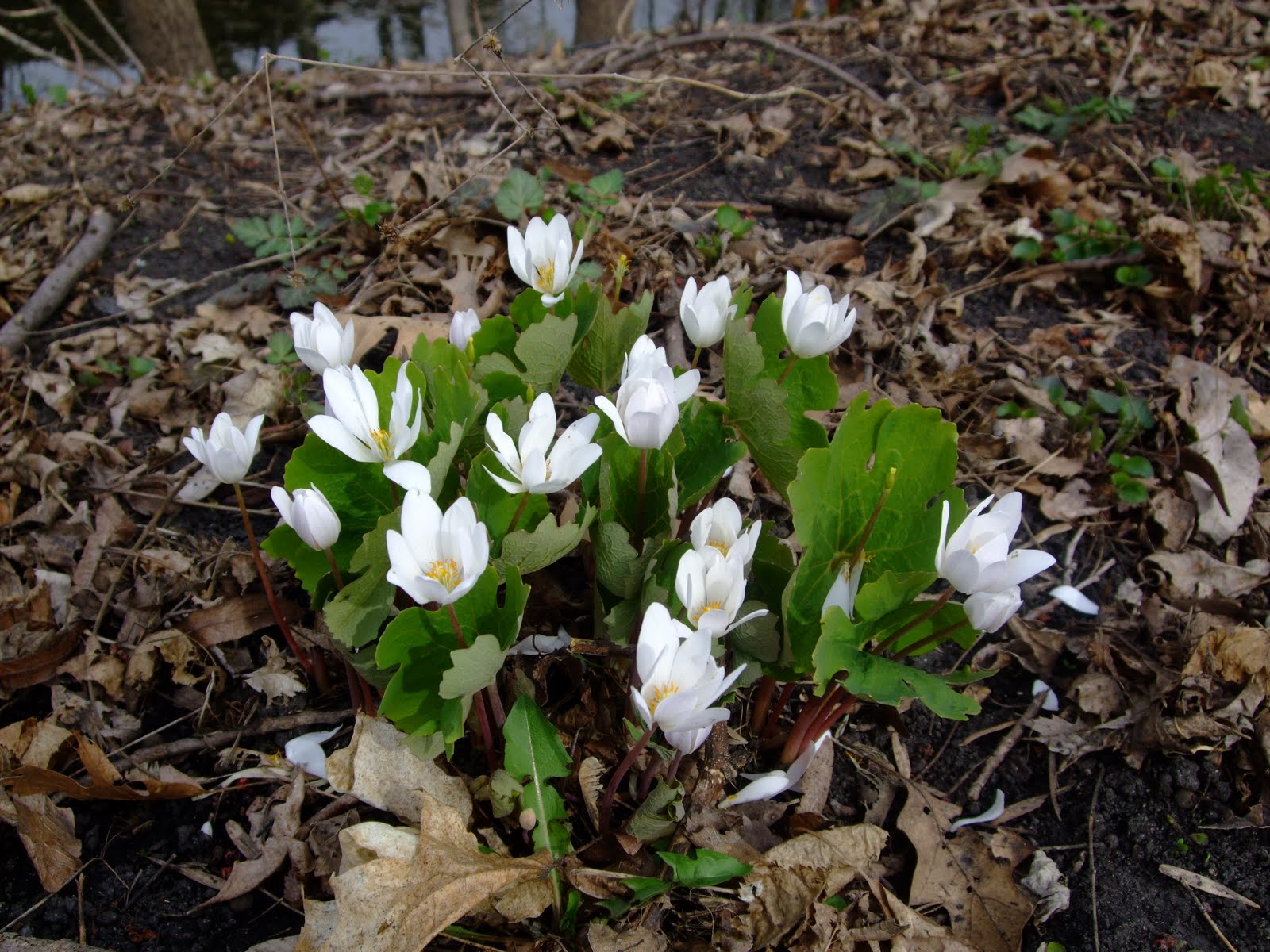
My sister-in-law and her husband recently bought a house. The backyard is heavily shaded and there is a stream running along the back property line. I checked out the flora growing back there when they moved in and the place is over-run with wild violets, though I did find a May Apple (fun!). This is their first spring in their new place, and a few days ago she discovered she has a small patch of bloodroot.


Bloodroot (Sanguinaria canadensis) is a wildflower native to North America. It's name is derived from the red-orange sap that runs freely from the rhizome root when cut. When my sister-in-law cut the flower to bring inside, red-orange liquid came out of the stem. I knew about the abundance of sap in the root, but it never occurred to me that it would be in the stems as well.

(Since I didn't want to damage my sis-in-law's plants, the above pic is from on a Google search.)


Bloodroot grows in conditions exactly where my sis-in-law found hers: moist or dry woods and thickets, usually on the shores of a pond or a stream. The flowers in her yard are widely dotted in an area about 10 x 10 feet. This is common for this little flower, as the rhizomes spread to form a nice little colony. Hers are only growing where beams of sun are breaking through the trees and between the houses.

Fun Fact: Although bloodroot spreads most efficiently by the rhizomes, it also produces seeds. The seeds are tiny, black discs that ants carry back to their nests. This provides the seeds with a wonderfully rich growing medium and helps start new bloodroot colonies. That is why we found a single flower 20 feet away from the main colony. (see lower right corner of the picture below).


The flowers bloom between March and May, are a bright, clear white, and have approximately eight petals. The leaves are initially curled around the flower stem, making it appear like the flower is coming out of a cocoon. The flowers are quickly pollinated so the bloom time is short-lived.


Once done blooming, the leaves unfold completely. The leaves are a unique, heavily lobed oval and will lie parallel to the ground in shadier locations. Bloodroot will go dormant in summer, so they are what is called a spring ephemeral.


Saturday, February 26, 2011

Field Trip: The Eloise Butler Wildflower Garden

Many colleagues and fellow plant geeks have always been astonished when they heard that I had never been to the Eloise Butler Wildflower Garden. Finally, in late May of 2008, I made the pilgrimage, and was astonished myself at why I had never been there before. This horticultural gem is hidden in Theodore Wirth Park in Minneapolis, Minnesota, and is a mere stone's throw from a major interstate and downtown Minneapolis. I have no doubt that the countless people who drive on I-394 have no idea what lies behind the strip malls and office buildings that line the sides of that concrete ribbon.

A little park history from the Minneapolis Park and Recreation Board: "The 15-acre garden is the oldest public wildflower garden in the nation. Its legacy dates back to 1907 when Minneapolis botanist Eloise Butler and botany teachers successfully petitioned the Minneapolis Park Board to create a natural botanic garden to preserve native flora as the city grew. Three acres of bog, meadow and hillside were properly fenced and the Wild Botanic Garden opened April 27, 1907." http://www.minneapolisparks.org/default.asp?PageID=4&parkid=340. In the 1940s, the park was expanded to the current 15 acres.

Once in the garden, you instantly forget you are in a bustling metropolitan city. The dirt path that meanders through the garden is nearly a mile long, and features multiple interpretive stations for the guided and self-guided tours. Home to over 500 plant species, many of them personally collected, planted and tended by Ms. Butler, there is a surprise around every corner. The Garden has something new to see throughout the seasons. Oh, and the proper fence is still there.

Here are pictures of my favorite plants from my walk through the Eloise Butler Wildflower Garden.
A lovely wild violet nodding near a trickling stream.
Viginia bluebells, Mertensia virginica.
American Larch (Larix laricina) just opening its soft whorls of needles.
Mayapples (Podophyllum peltatum) among Swamp Buttercup (Ranunculus hispidus). 
Wild Geranium, Geranium maculatum.
Large-flowering Trillium, Trillium grandiflorum.
Red Trillium, Trillium erecta.
I believe this is a fading Red Trillium flower.
Still pretty, though.
I still cannot figure out what this Mystery Shrub is.
Could it be an Eastern Wahoo? Euonymus atropurpureus.
Interrupted Fern, Osmunda claytoniana.
An Interrupted Fern Forest!
And there's much more where these came from! I highly recommend making your own pilgrimage to the Eloise Butler Wildflower Garden this year. Not only is it a great way to escape the business of the city and lose yourself in the beauty of nature, but it's free!